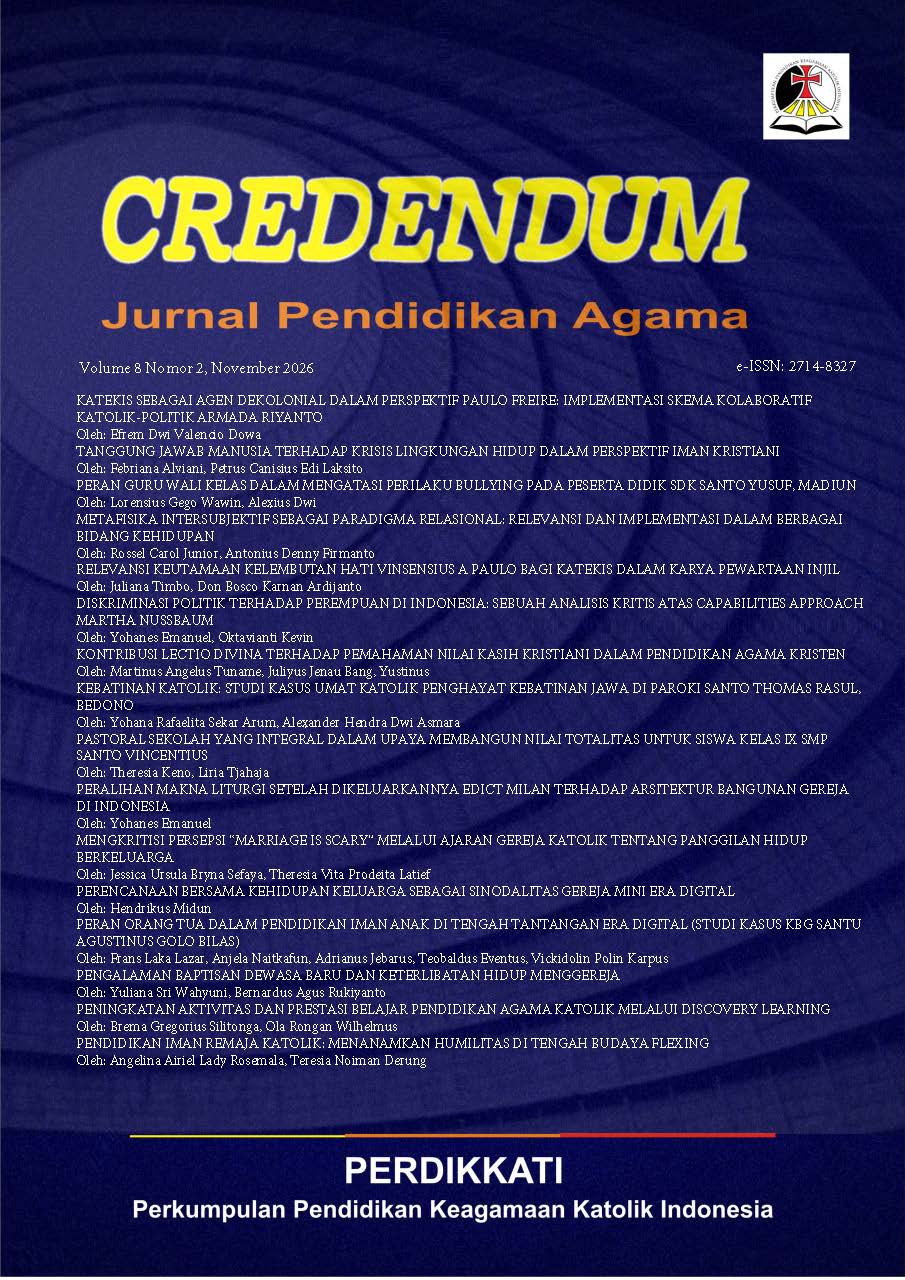
PERAN GURU WALI KELAS DALAM MENGATASI PERILAKU BULLYING PADA PESERTA DIDIK SDK SANTO YUSUF, MADIUN
DOI:
https://doi.org/10.34150/credendum.v8i1.1038Keywords:
bullying, accompanying teachers, bullying prevention strategies, catholic elementary schoolAbstract
The study aim to understand the role of an accompanying teacher to address so called bullying actions done by the students at the Catholic Elementary School of Saint Joseph, Madiun city. The study then covered three major aspects, which were the role of accompanying teacher to address bullying cases, identification the forms of bullying cases committed by the students, and the strategy to prevent bullying cases that might be emerged. The study applied a qualitative method with a case study approach. Data was collected by using so called in-depth interview, direct observation, and documentation techniques. There were seven informants selected for the study, they were a head mater of the school, and six accompanying teachers. These all informants selected using a purposive sampling technique. Data was analyzed using Creswell's interactive analysis model, which including the stages of data organization, data reduction, data coding, and drawing of the conclusion. The results of the study indicated that the accompanying teachers had played an important role as an educator, supervisor, mediator, and facilitator in handling bullying cases committed in the school. The forms of bullying committed by the students in the school were including verbal, physical, and psychological bullying, with verbal bullying being mostly done by the students.
References
Bida, A., Warwas, I., Gajdzik, B., & Poteralska, B. (2022). Preventing bullying in schools through educational activities. Problems of Education in the 21st Century, 80(1), 5–18.
Coloroso, B. (2006). The bully, the bullied, and the bystander: From preschool to high school-how parents and teachers can help break the cycle. New York: HarperCollins.
Creswell, J. W. (2007). Penelitian kualitatif & desain riset: Memilih di antara lima pendekatan, model spiral data. Yogyakarta: Pustaka Pelajar.
Darmawan, S. (2020). Psikologi Sosial dalam Pendidikan. Bandung: Remaja Rosdakarya.
Darmiany, N. & Sari, F. P. (2022). Strategi Guru dalam Menangani Bullying di Sekolah Dasar. Yogyakarta: Pustaka Pelajar.
Etymonline. (2025). Bully-Etymology, Origin & Meaning. https://www.etymonline.com/search?q=Bully%20%E2%80%93%20Etymology%2C%20Origin%20%26%20Meaning
Hamalik, O. (2007). Manajemen Pengajaran. Jakarta: Bumi Aksara.
Haryadi. (2023). Strategi Kolaboratif dalam Pendidikan: Pencegahan dan Penanganan Bullying di Sekolah Dasar. Jakarta: Prenada Media.
Haryadi. (2023). Pendidikan Karakter dan Pencegahan Perilaku Menyimpang di Sekolah. Yogyakarta: Deepublish.
Harper, D. (2023). Online Etymology Dictionary. Diambil dari https://www.etymonline.com/word/bully
Koval, N. (2022). Preventive Strategies in Educational Settings: A Guide for Teachers. Berlin: Education Insights Press.
Kuraesin. (2019). Pendidikan Karakter: Strategi Preventif dalam Pembentukan Kepribadian Siswa. Bandung: Alfabeta.
Kurniati, D. (2021). Psikologi Anak dan Remaja dalam Konteks Pendidikan. Yogyakarta: Deepublish.
Marjohan. (2012). Psikologi Konseling. Padang: UNP Press.
Montague, M., Enders, C., Castro, M. (2017). Collaboration in Education: A Practical Guide for Building Partnerships. New York: Routledge.
Mulyasa. (2009). Menjadi Guru Profesional: Strategi Meningkatkan Kualitas Guru di Era Global. Bandung: Remaja Rosdakarya.
Mulyasa, E. (2013). Menjadi Guru Profesional. Bandung: Remaja Rosdakarya.
Novianto, P. (2024). Kekerasan Pada Anak di Satuan Pendidikan. Idntimes.com. https://pusaka.dpr.go.id
Sarwono, S. W. (2002). Psikologi Remaja. Jakarta: Rajawali Pers.
Sukmadinata, N. S. (2012). Landasan Psikologi Proses Pendidikan. Bandung: Remaja Rosdakarya.
Surya, M. (2004). Psikologi Guru: Cara Mengelola Kelas Secara Efektif. Bandung: Alfabeta.
Suyanto, S. (2013). Masalah Sosial Anak dan Remaja. Yogyakarta: Gava Media.
Downloads
Published
Issue
Section
License
Copyright (c) 2026 Lorensius Gego Wawin, Alexius Dwi Widiatna

This work is licensed under a Creative Commons Attribution-NonCommercial-ShareAlike 4.0 International License.