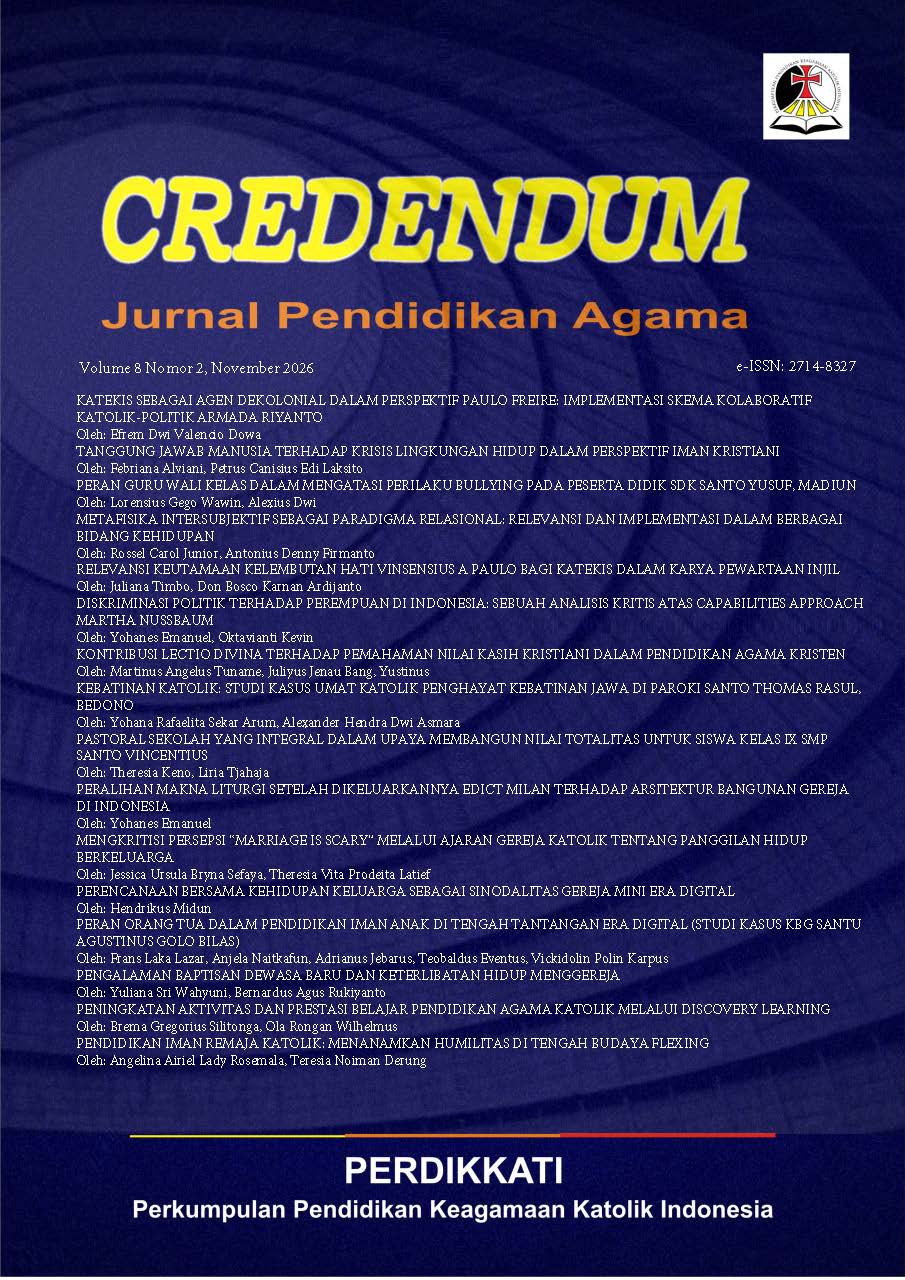
MENGKRITISI PERSEPSI “MARRIAGE IS SCARY” MELALUI AJARAN GEREJA KATOLIK TENTANG PANGGILAN HIDUP BERKELUARGA
DOI:
https://doi.org/10.34150/vdxkcy85Keywords:
Catholic Marriage, Catholic Youth, Marriage is Scary, Vocation to Family LifeAbstract
This research is motivated by the growing perception of “marriage is scary” among young people. Such concerns often stem from exposure to digital content, personal and vicarious experiences, financial pressures, and the perceived challenges of raising children. This perception has also affected Catholic youth, raising concerns considering the Catholic Church’s teaching on the vocation to family life. This study aims to analyze how young Catholics (Orang Muda Katolik [OMK]) understand the vocation to family life and how this understanding can be used to critique the “marriage is scary” perception.Unlike previous studies that primarily examine the phenomenon from psychological or sociological perspectives, this research offers a theological and pastoral analysis grounded in the Catholic Church’s teaching on the vocation to family life.The study employed a descriptive qualitative approach through Focus Group Discussions (FGDs) involving fourteen OMK members from St. Paul Parish, Depok. The discussions focused on four themes: OMK’s understanding of the vocation to family life, their perception of “marriage is scary,” their critique of this perception, and its pastoral implications.The findings indicate that OMK generally posses a sound understanding of the Church’s teaching on family life. Nevertheless, the “marriage is scary” perception remains present among them. This concern does not reflect indifference toward God’s plan; rather, it encourages OMK to approach the commitment to family life more thoughtfully and responsibly in accordance with Catholic teaching. Based on these findings, the study recommends that the Church organize educational programs on the vocation to family life, develop social media content (such as reels, podcasts, and short articles) that promotes the values of Catholic marriage, and expand youth-oriented activities that foster personal and spiritual growth. Furthermore, OMK are encouraged to critically evaluate digital content/culture related to marriage considering the Church’s teachings.
References
Adrian, K. (2024). Mengenal gamophobia, ketakutan untuk berkomitmen dan menikah. Alodokter. https://www.alodokter.com/mengenal-gamophobia-ketakutan-untuk-berkomitmen-dan-menikah
Alkitab Deuterokanonika. (2009). Lembaga Alkitab Indonesia.
Azizah, M., Aini, N. N., Sari, S., & Hamzah, M. A. (2025). Pengaruh fenomena “Marriage is scary” terhadap stigma pernikahan dan perilaku seksual pranikah pada generasi muda. ETNOREFLIKA: Jurnal Sosial dan Budaya, 14(2), 265–275. https://doi.org/10.33772/etnoreflika.v14i2.3026
Bergant, D., & Karris, R. J. (Eds.). (2002a). Tafsir Alkitab Perjanjian Baru (A. S. Hadiwiyata, Penerj.). Kanisius.
Bergant, D., & Karris, R. J. (Eds.). (2002b). Tafsir Alkitab Perjanjian Lama (A. S. Hadiwiyata, Penerj.). Kanisius.
Brooks, K. R. (2002). Paul’s inspired teachings on marriage. In Go ye into all the world: Messages of the New Testament apostles (31st Annual Sidney B. Sperry Symposium, pp. 75–97). Deseret Book.
Fadli, R. (2022). Ini dampak fisik dan psikologis bagi korban KDRT. Halodoc. https://www.halodoc.com/artikel/ini-dampak-fisik-dan-psikologis-bagi-korban-kdrt
Fajar. (2025). Angka pernikahan di Indonesia turun drastis, Kemenag imbau generasi muda. dki.kemenag.go.id. https://dki.kemenag.go.id/berita/angka-pernikahan-di-indonesia-turun-drastis-kemenag-imbau-generasi-muda-crh9Y
Fransiskus. (2016). Sukacita kasih: Amoris laetitia. Dokpen KWI.
Hahn, S. (2009). Kinship by covenant: A canonical approach to the fulfillment of God’s saving promises. Yale University Press.
Hansari, H. (2025). Mengenal Gen Z, generasi rawan depresi hingga si paling self reward. Badan Pusat Statistik Kabupaten Kota Baru. https://kotabarukab.bps.go.id/id/news/2025/05/19/345/mengenal-gen-z-generasi-rawan-depresi-hingga-si-paling-self-reward.html
Henry, M. (2015). Tafsiran Matthew Henry: Surat Galatia, Efesus, Filipi, Kolose, 1 & 2 Tesalonika, 1 & 2 Timotius, Titus, Filemon (I. Ardaneswari, H. Aprilani, L. Murtihardjana, P. A. Rajoe, V. Setyawati, & T. Susilawati, Penerj.). Momentum.
Ishak, M., Baydhowi, B., Mahfud, M., & Mas’odi, M. O. (2025). Gen Z dalam dunia pendidikan. Jurnal Multidisiplin Ilmu Akademik, 2(1), 328–338. https://ejurnal.kampusakademik.co.id/index.php/jmia/article/view/3351
Isnur, P. (2025). Benarkah angka pernikahan turun? Indonesia Baik. https://indonesiabaik.id/infografis/benarkah-angka-pernikahan-turun
Jaya, I. M. L. M. (2020). Metode penelitian kuantitatif dan kualitatif: Teori, penerapan, dan riset nyata. Anak Hebat Indonesia.
Katekismus Gereja Katolik (edisi ke-2). (1997). https://www.imankatolik.or.id/katekismus.php?q=1603
Kitab Hukum Kanonik. (1983). https://www.imankatolik.or.id/khk.php?q=1055-1071
Krismono, Oktaviani, D. (2025). Analysis of the marriage is scary phenomenon among Generation Z: A perspective of Islamic law sociology. Sharia and Humanities, 2(1), 422–439. https://doi.org/10.61159/sahaja.v4i1.403
Kristyowati, Y. (2021). Generasi “Z” dan strategi melayaninya. Ambassadors: Jurnal Teologi dan Pendidikan Kristiani, 2(1), 23–34. https://stt-indonesia.ac.id/journal/index.php/ambassadors/article/view/22
Kulathunga, A., & Abeysinghe, N. (2024). Love and marriage in the eyes of Gen Z: A qualitative exploration [Paper presentation]. SLIIT International Conference on Advancements in Sciences and Humanities.
Narasi Newsroom. (2026). Di balik tren menurunnya angka pernikahan di Indonesia; alasan ekonomi, gaya hidup, dan ketakutan lainnya [Infografik]. Instagram. https://www.instagram.com/p/DTmPxdVE_Pj/
Nasution, A. F. (2023). Metode penelitian kualitatif. CV Harfa Creative.
Nisa, A. I. (2024). Persepsi gamophobia pada Gen Z dampak dari kasus perceraian orang tua. SABANA (Sosiologi, Antropologi, dan Budaya Nusantara), 3(2), 243–248. ttps://doi.org/10.55123/sabana.v3i3.3361
Perangin Angin, Y. H., & Yeniretnowati, T. A. (2024). Studi teologis keluarga rancangan Allah berdasarkan Kejadian 2:15–25. Jurnal Murid Kristus, 1(1), 83–97. https://jurnal.sttrmk.ac.id/index.php/sttrmk/index
Putri, H. (2025). Marriage is scary trend: Narratives of fear of marriage for women. Global Society Journal, 2(1), 11–24. https://doi.org/10.31947/gs.v2i1.45155
Riska, H. (2023). Faktor yang memengaruhi persepsi menunda pernikahan pada Generasi Z. Indonesian Health Issue, 2(1), 48–53.
Rofiqoh, I., & Zulhawati. (2020). Metode penelitian kuantitatif, kualitatif, dan campuran. Pustaka Pelajar.
Sandy, O. P. (2025). Mengenal gamophobia: Ketakutan berkomitmen dan menikah di kalangan generasi muda. Validnews. https://validnews.id/catatan-valid/mengenal-gamophobia-ketakutan-berkomitmen-dan-menikah-di-kalangan-generasi-muda
Sarra Marco Uncut. (2025). #SMU S1EPS8: Why marriage is scary [Video]. YouTube. https://youtu.be/s1kSaGVdw3A
Sembiring, T. B., Irmawati, Sabir, M., & Tjahyadi, I. (2024). Buku ajar metodologi penelitian: Teori dan praktik. CV Saba Jaya Publisher.
Setyowati, D. (2024, 26 Oktober). Angka pernikahan di Indonesia turun: Wanita mandiri banyak, pria mapan sedikit. Katadata. https://katadata.co.id/berita/nasional/671ca4703017e/angka-pernikahan-di-indonesia-turun-wanita-mandiri-banyak-pria-mapan-sedikit
Tirta, K. D. (2025). Studi fenomenologi: Marriage is scary pada Generasi Z. Teraputik: Jurnal Bimbingan dan Konseling, 5(1), 12–20. https://doi.org/10.26539/teraputik.833675
Wandi. (2025). Angka perkawinan anak dan dewasa di Indonesia: Perubahan sosial dan kesadaran kolektif. Portal Informasi Indonesia. https://indonesia.go.id/kategori/feature/9735/angka-perkawinan-anak-dan-dewasa-di-indonesia-perubahan-sosial-dan-kesadaran-kolektif?lang=1
Yohanes Paulus II. (1981). Keluarga: Familiaris consortio. Dokpen KWI.
Downloads
Published
Issue
Section
License
Copyright (c) 2026 Jessica Ursula Bryna Sefaya, Theresia Vita Prodeita Latief

This work is licensed under a Creative Commons Attribution-NonCommercial-ShareAlike 4.0 International License.