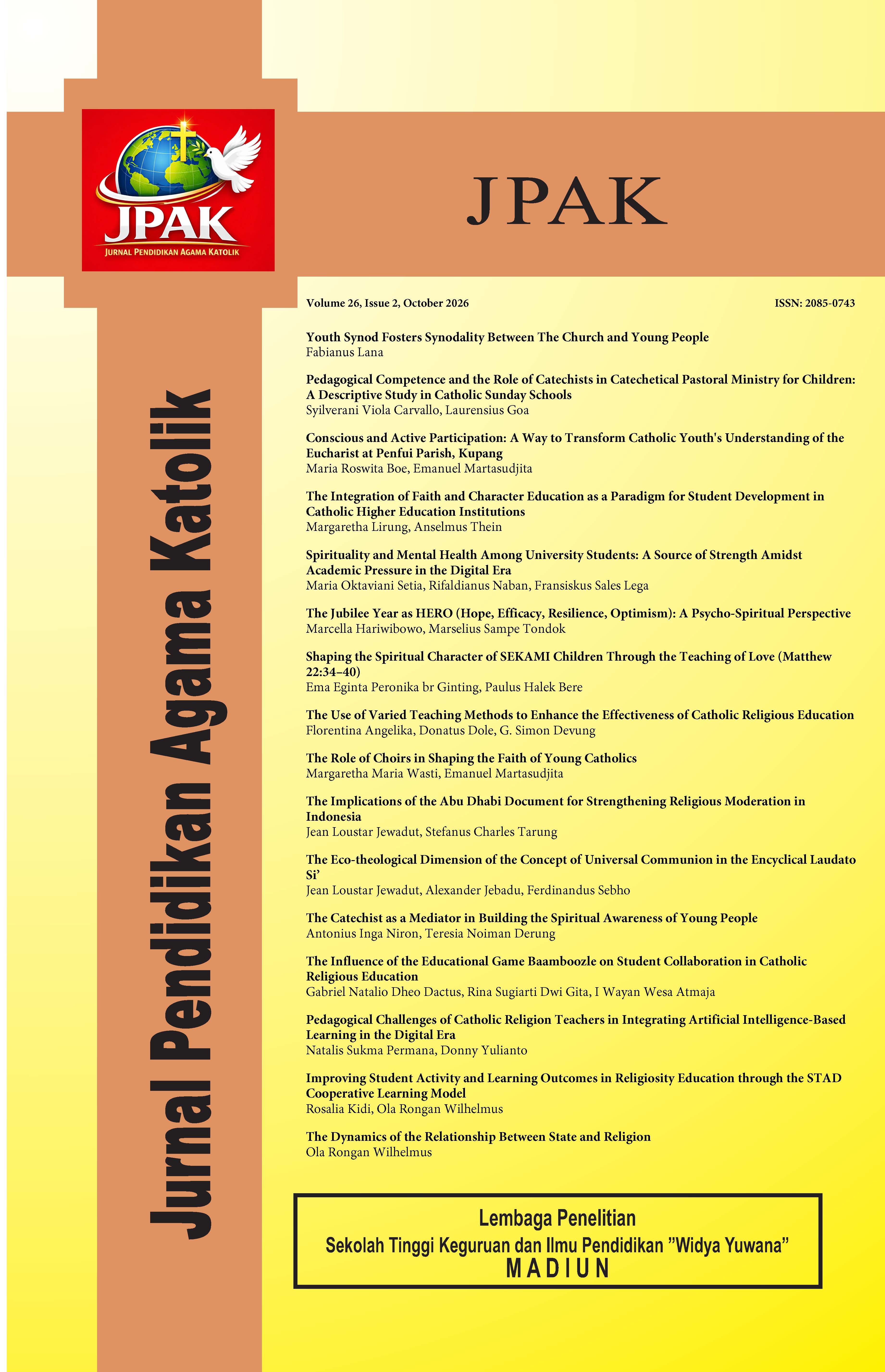
The Dynamics of the Relationship Between State and Religion
DOI:
https://doi.org/10.34150/k6eww717Keywords:
Secular State, Theocratic State, Religious Nation-StateAbstract
In the period leading up to and following Indonesian independence, the relationship between religion and the state was fiercely debated between supporters of a secular state and supporters of a theocratic (religious) state. Advocates of a theocratic state held that Western secularism could weaken the influence of religion in national and public life, and they wanted Islam to be the religion and the legal basis of the state. Supporters of a secular state, by contrast, held that secularism was the best choice if religion and the state were each to fulfill their own tasks and functions. After a lengthy debate, the religious-nationalist leaders and the people agreed to establish Indonesia as a religious nation-state. Such a state recognizes religious values without positioning any particular religion or religious teaching as the state religion or the basis of state law.Using a qualitative, this article aims to examine the basic concepts of the secular state and the theocratic state, as well as Indonesia as a religious nation-state and the challenges it faces. It is a qualitative library study. A critical evaluation of the literature reveals that a secular state strictly separates religious institutions from the state. A theocratic state establishes a particular religion as the state religion and positions divine law as the supreme law of the state. A religious nation-state recognizes divine values but does not adopt the teaching of any particular religion as the state religion and the basis of state law.
References
Abbas, R., & Danial, M. (2022). Relasi agama dan negara (Studi komparasi pemikiran Nurcholis Madjid dan Abdurrahman Wahid) [Religion and state relations: Comparative study of the thoughts of Nurcholis Madjid and Abdurrahman Wahid]. Constitution Journal, 1(1), 19–34. https://doi.org/10.35719/constitution.v1i1.5
Al-Quran Online. (n.d.). Surat Al-Anbiya' ayat 107: Arab, Latin, terjemahan. https://quran.com/id/para-nabi/107
Amelia. (2025). Nasionalisme religius, perekat Indonesia yang beragam. https://kkn.iainpare.ac.id/en/blog/opinion-5/nasionalisme-religius-perekat-indonesia-yang-beragam-5057
Azra, A. (2002). Reposisi hubungan agama dan negara: Merajut kerukunan antara umat. Jakarta: Kompas.
Barton, G. (2026). The authorized biography of Abdurrahman Wahid (2nd Equinox ed.). Jakarta: PT. Equinox Publishing Indonesia
Driscoll, J. F. (2026). Theocracy: A form of civil government in which God himself is recognized as the head. https://www.catholic.com/encyclopedia/theocracy
Effendy, B., & Fausi, I. A. (2011). Islam dan negara: Transformasi pemikiran dan praktik politik Islam di Indonesia. Jakarta: Paramadina. https://opac.perpusnas.go.id/DetailOpac.aspx?id=466570
Hidayatulloh, T., & Saumantri, T. (2023). The harmony of Islam and Pancasila in religious discourse in Indonesia. Jurnal Studi Sosial Keagamaan Syekh Nurjati, 3(1), 1–25. https://doi.org/10.24235/sejati.v3i1.36
Hutabarat, B. A. (2018). Ambiguitas dan Diferensiasi Agama dan Negara di Indonesia. Societas Dei: Jurnal Agama dan Masyarakat, 5(1), 7-7. https://doi.org/10.33550/sd.v5i1.76
Jegalus, N. (2013). Hubungan antara negara dan gereja: Implikasinya terhadap penyelenggaraan pendidikan agama dan pendidikan keagamaan. Jurnal Ledalero, 12(2), 191-220.
Kamdani, R., Azis, R., & Triadi, R. (2025). Relasi agama dan negara dalam bingkai NKRI. GJMI: Gudang Jurnal Multidisiplin Ilmu, 3(1), 1008–1013. https://gudangjurnal.com/index.php/gjmi/article/view/1397
Khatibah, K. (2011). Penelitian kepustakaan. Iqra': Jurnal Perpustakaan dan Informasi, 5(1), 36–39. https://ejournal.uinib.ac.id/jurnal/index.php/naturalscience/article/view/1555
Komisi Pemilihan Umum Kabupaten Mamberamo Tengah. (2025). Teokrasi adalah: Pengertian, ciri, dan contoh negara teokrasi di dunia. https://kab-mamberamotengah.kpu.go.id/blog/read/8536_teokrasi-adalah-pengertian-ciri-dan-contoh-negara-teokrasi-di-dunia
Lukito, R. (2018). Diskusi publik "Negara dan agama". Undang: Jurnal Hukum. https://ujh.unja.ac.id/index.php/home/other/seminar/diskusiNegara-Agama/
Mas'udi, M. F. (2026). Meredefinisi hubungan agama dan negara. Retrieved from http://www.icrp-online.org/wmview.php?ArtID=174
Masruro, A., Astrid, E., & Shafa, R. (2022). Agama dan tingginya korupsi di negara religius. Balairungpress. https://www.balairungpress.com/2022/04/agama-dan-tingginya-korupsi-di-negara-religius/
Meanvis. (2026). Theocracy meaning in politics: Easy guide for beginners. https://meanvise.com/theocracy-meaning/
Muvid, M. B. (2025). Nasionalisme dan agama: Merajut bingkai kebangsaan berbasis spiritual. Global Islamika: Jurnal Studi dan Pemikiran Islam, 4(1), 69–80. https://doi.org/10.5281/zenodo.16478651
National Secular Society. (2025). Secularism explained: Equal treatment and freedom for all. https://www.secularism.org.uk/what-is-secularism
Presidentcbk. (2010). Science Po Master of Public Affairs graduation. https://presidentcbk.lk/2010/06/10/secularism-and-the-state/
Rochmat, S. (2014). The fiqh paradigm for the Pancasila state: Abdurrahman Wahid's thoughts on Islam and the Republic of Indonesia. Al-Jami'ah: Journal of Islamic Studies, 52(2), 309–329. https://doi.org/10.14421/ajis.2014.522.309-329
Sadzali, A. (2020). Hubungan agama dan negara di Indonesia: Polemik dan implikasinya dalam pembentukan dan perubahan konstitusi. Undang: Jurnal Hukum, 3(2), 341–375. https://doi.org/10.22437/ujh.3.2.341-375
Saifuddin, L. H. (2015). Relasi agama dan negara saling membutuhkan. Retrieved from https://kemenag.go.id/nasional/menag-relasi-agama-dan-negara-saling-membutuhkan-pbm3k0
Sari, M., & Asmendri. (2020). Penelitian kepustakaan (Library research) dalam penelitian pendidikan IPA. Natural Science: Jurnal Penelitian Bidang IPA dan Pendidikan IPA, 6(1), 41–53. https://doi.org/10.15548/nsc.v6i1.1555
Sucahyo, N. (2018). Aneh, masyarakat religius namun korupsi tinggi. VOA Indonesia. https://www.voaindonesia.com/a/aneh-masyarakat-religius-namun-korupsi-tinggi/4587783.html
Sugiyono. (2012). Metode penelitian kuantitatif, kualitatif, dan R&D. Alfabetta.
Suparto. (2019). The relationship between religion and state according to the Constitution of the Republic of Indonesia 1945. International Journal of Innovation, Creativity and Change, 10(5), 148–159. https://repository.uir.ac.id/23109/
Tempo. (2024). Survei menunjukkan Indonesia negara paling taat beribadah di dunia. https://www.tempo.co/internasional/survei-menunjukkan-indonesia-negara-paling-taat-beribadah-di-dunia-17441
Transparency International. (2025). Indeks korupsi Indonesia. Trading Economics. https://id.tradingeconomics.com/indonesia/corruption-index
Tsania, R. Z. (2025). Konsep dakwah rahmatan lil 'alamin dalam pemikiran tokoh modern Islam: Analisis komparatif pemikiran Nurcholish Madjid dan Abdurrahman Wahid. IKHBAR: Jurnal Ilmu Dakwah dan Komunikasi, 1(1), 15–23. https://doi.org/10.65823/ikhbar.11i1.2
Umar, N. (2017a). Agama negara, negara agama, & negara sekuler (2). RMOL.id. https://rmol.id/read/2017/08/13/302847/agama-negara-negara-agama-negara-sekuler-2
Umar, N. (2017b). Pancasila & nasionalisme Indonesia (2): Nasionalisme terbuka (1). RM.id. https://rm.id/baca-berita/kolom/29067/pancasila-dan-nasionalisme-indonesia-2-nasionalisme-terbuka-1
Utomo, W. B. (2025). Teo-demokrasi: Fenomena demokrasi (model) Republik Islam Iran. https://kota-salatiga.kpu.go.id/blog/read/teo-demokrasi-fenomena-demokrasi-model-republik-islam-iran
Uzlaner, D., & Stoeckl, K. (2019). From Pussy Riot's 'punk prayer' to Matilda: Orthodox believers, critique, and religious freedom in Russia. Journal of Contemporary Religion, 34(3), 427-445. https://doi.org/10.1080/13537903.2019.1658432
Downloads
Published
Issue
Section
License
Copyright (c) 2026 Ola Rongan Wilhelmus

This work is licensed under a Creative Commons Attribution-NonCommercial-ShareAlike 4.0 International License.

This work is licensed under a Creative Commons Attribution-NonCommercial-ShareAlike 4.0 International License